Figures, dates and what the operator wants up front
- The figure
- from $4,190 per person
- Nights
- 8
- Season
- October to April
- At reservation
- 10 per cent at reservation
The operating company asks for ten percent of the figure, $419 per person, when the reservation is confirmed, and the balance sixty days before departure.
Fixed departures
- 7 to 15 November 2026
- 16 to 24 January 2027
- 20 to 28 March 2027
These are dates, not a range to slide around. A departure with no date attached is a different kind of contract altogether and this office does not write those.
Inside the figure
- Eight nights in mountain guest houses and small hotels, two sharing a room
- A four wheel drive vehicle with a driver for every day of the trip
- An Omani mountain guide on all walking days
- Entry fees for the sites and viewpoints on the route
- Breakfast every day, plus five evening meals
Left out
- International flights to and from Oman; reaching the country is not covered by the figure
- Visas and travel insurance, which the traveller arranges independently
- Lunches, drinks and three evening meals
- Single occupancy, which the operating company prices separately
Water is measured in minutes, not in gallons
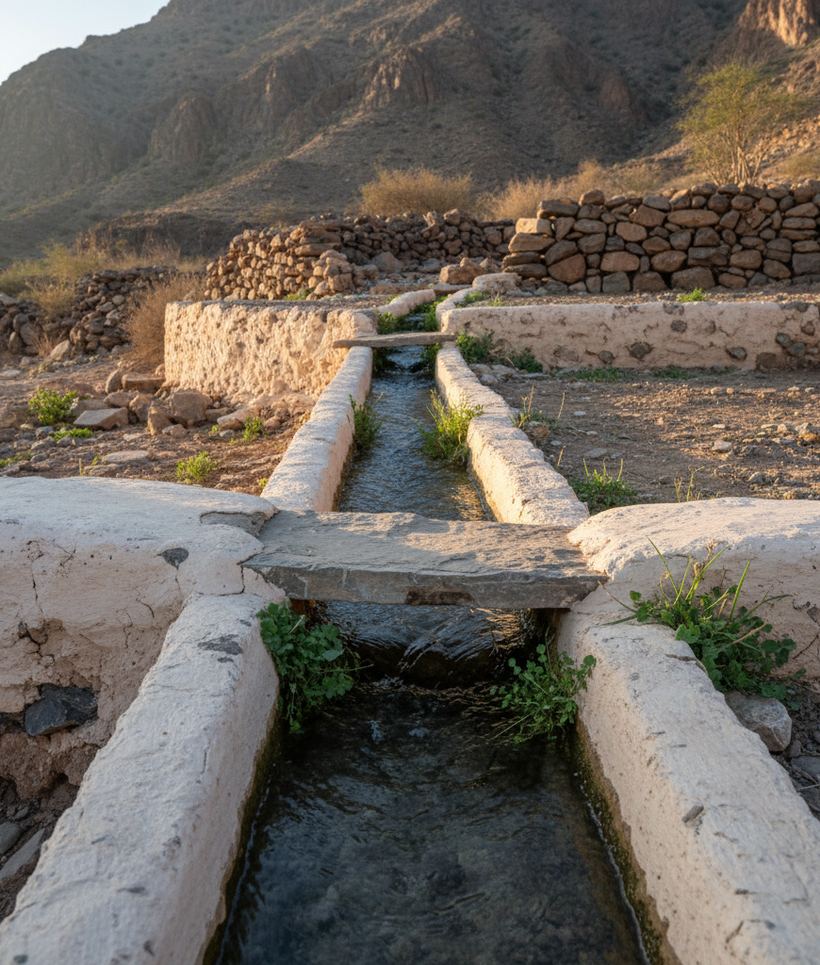
A guided walking trip in the Hajar mountains is really a trip about water. Rain falls on the range in short bursts and disappears into the rock. The falaj system brings it back out: a tunnel driven into the hillside until it meets the water level, then a channel cut along the contour, sometimes for kilometres, dropping only a few centimetres in each hundred metres.
At the village the channel runs open, lined with stone, about a hand span wide. Shares are sold in units of time rather than volume. A household buys so many minutes of the whole flow, and when its turn comes the water is turned into its terrace with a flat slab.
Turns were once timed by the sun in daylight and by named stars at night. Five of these systems are on the world heritage list. Several have run without a break for well over a thousand years.
Walk the ledge to the abandoned village
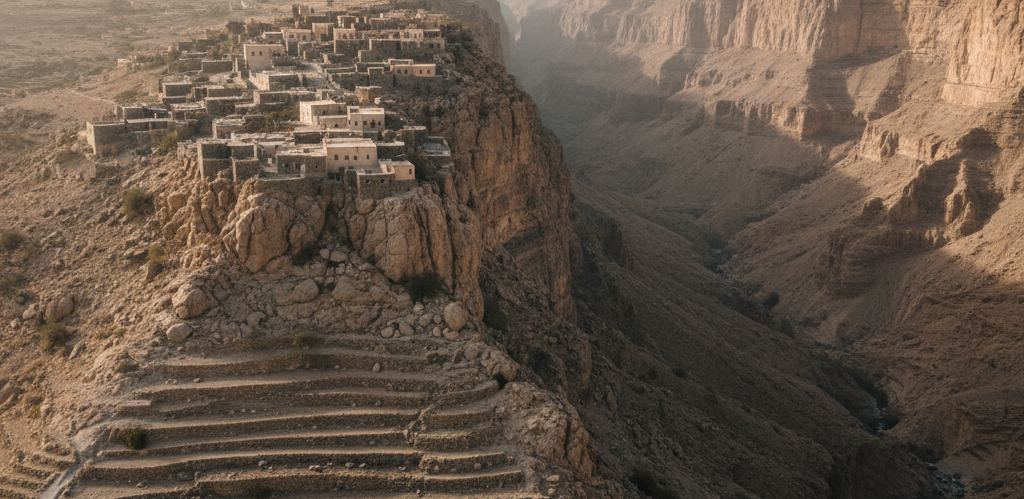
The best known walk here starts at a village on the rim of Wadi Nakhr and follows a ledge cut into the canyon wall. It was a working path between settlements, not a route made for visitors, and it stays roughly level for about three kilometres.
The drop is on one side the whole way. In two or three places the ledge narrows to a metre, with nothing between the path and several hundred metres of air. It is not climbing and there is no rope, but people who dislike edges dislike this.
At the end the path turns into a bay under an overhang. A small village sat there, built of mud and stone against the rock, with its own spring and a few terraces. It was left in the 1970s. The walls still stand, the water still runs, and the terraces read as lines of stone under the dust. Four hours in and out, with a stop.
Two mountains, one switchback road
The trip works two areas. Jebel Akhdar is a plateau at about two thousand metres, reached by a single paved road with a checkpoint at the bottom where four wheel drive is required and checked. Jebel Shams is higher, just over three thousand, and the last stretch to the rim is graded gravel with long switchbacks and no wall on the outside.
Neither drive is long in kilometres. Both take much more time than the distance suggests, and both end well above where they start, so the temperature falls as you go.
Nights are cold from December to February. Frost on the Saiq plateau is normal, and the rim of Jebel Shams can sit near freezing after dark. Rooms in the mountains are heated unevenly. In the last days of March the roses on the terraces are cut for distilling, and the small stone sheds in the villages run for about three weeks.
What is left on the terraces
Photographs of these villages show terraces in full use. On the ground a good share of them are not worked any more. Younger people took jobs in Muscat and in the oil sector, the walls need constant repair, and one collapsed wall takes out the beds below it.
You will walk past dry terraces with grass in them, houses with the doors gone, and channels still running past ground nobody planted. This is not ruin exactly. Families often keep the old house and come back for part of the year. It does mean the landscape you are looking at is being kept up by fewer hands each decade.
The Saiq plateau has the opposite problem. Hotel building along the rim has been fast, the good viewpoints have parking lots, and on a Friday afternoon in season the popular ones fill up. Walk early if you want the terraces quiet, and expect the middle of the day to be busier than the pictures suggest.
Where $4,190 else goes
This departure sits on the $4,190 rung, and it is not alone there. The office keeps every trip at that figure on one page so the number can be seen doing different work in different parts of the world. It does not rank them and will not tell you which is the better buy, because that is not a judgement a figure supports.
The same $4,190 somewhere else entirely
These 2 cost exactly what this one costs, and resemble it in nothing else. That is the point of filing a catalogue by figure. The office sets them out and leaves the choosing to you.
Start from the figure you actually have
Requests are taken every hour of every day. A person reads what this collects and writes back inside one business day. Money never changes hands here, and this office holds no card details of yours at any stage.
Orchard and Oar Bookings LLC
1401 E Broward Blvd, Suite 305Fort Lauderdale, FL 33301
+1 (954) 522-3140Calls run one way only: this office answers what reaches it and starts nothing of its own, by voice or by message.
reservations@orchardandoar.com
No opening times are posted. What is promised instead is the wait: a written request is answered inside one business day, and that is the undertaking the office will be held to.